 KIDS RIDE-ON TOYS WHOLESALE
authority / BUYER DESK
Electric Ride On Cars Wholesale: Wh, Soft-Start, 2.4G
Wholesale electric ride on cars: compute 12V 7Ah = 84 Wh vs 24V 7Ah = 168 Wh, specify PWM soft-start and 2.4 GHz override priority, and lock CPC battery/charger files.
Published 2026-11-26
A distributor opens two electric ride on cars wholesale quotes side by side. Quote A lists a 12 V 7 Ah battery; Quote B lists a 24 V 7 Ah battery. Both sheets print the same 7 Ah, both print a 2.4 GHz remote, and neither prints a watt-hour figure, a soft-start ramp time or a command-priority rule. The buyer is being asked to compare platforms on the one number that says least about stored energy.
RideOnToys publishes this catalog as a sourcing desk, not a factory: model platforms, representative SKUs, packing references and configuration questions sit in five procurement groups, and price, MOQ, battery, speed, load, age, certification, licensing and delivery stay quotation- or document-dependent until a model-level file exists.
This article gives the buyer three engineering handles that survive quotation changes: watt-hours for pack comparison, PWM duty-cycle ramp for toddler acceleration, and a written priority rule for the 2.4 GHz parental override. It then maps those handles to the US consumer product safety authority battery, charger, CPC and material-change documents a U.S. importer must hold.
Why 7 Ah Alone Cannot Compare a 12 V and a 24 V Ride-On Platform
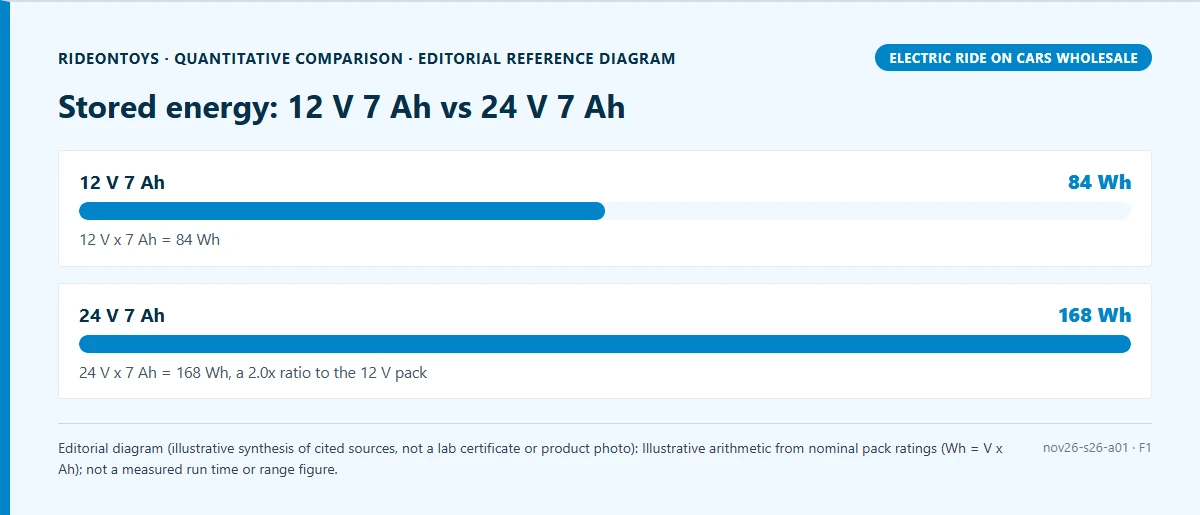
Amp-hours count charge; watt-hours count energy. Multiply volts by amp-hours and the two quotes separate: 12 V x 7 Ah = 84 Wh, while 24 V x 7 Ah = 168 Wh. The 24 V pack stores exactly twice the energy at the same 7 Ah label, and a buyer who compares only 7 Ah treats a 84 Wh pack and a 168 Wh pack as identical.
That doubling is a documentation and thermal question before it is a performance question. A 168 Wh pack paired with a charger sized for an 84 Wh pack changes the charge current profile, the heat generated during charging and the protection thresholds the battery management system must enforce. US consumer product safety authority staff reports incidents occurring while the product is in use, in storage and during battery charging, and lists overheating, fire, electrical shock from battery chargers, thermal burns, exposure to alkaline battery electrolytes and high-velocity ejected internal components as potential hazards. US consumer product safety authority also records recalls involving batteries used in battery-powered ride-on toys.
Watt-hours do not prove double the run time and do not prove double the speed. US consumer product safety authority staff recommends a system approach covering thermal protection and charge and discharge protection, with cells suitable for the intended loads and packs built with proper battery management systems, and states batteries must be tested with the product and with the charger as a system. A 168 Wh figure tells the buyer to request that system file; it does not replace it.
Gear ratio sits on the other side of the same comparison. Teach Engineering frames gear selection as a trade-off between speed and torque, where a gear set must supply enough torque for the load while reaching the fastest speed possible. A 24 V pack feeding a tall gear ratio and a 12 V pack feeding a short gear ratio can post similar top speeds with very different torque margins, which is why the quotation needs voltage, amp-hours, gear ratio and motor rating on one line.
Illustrative arithmetic from nominal pack ratings (Wh = V x Ah); not a measured run time or range figure.The Watt-Hour Worked Example: 84 Wh vs 168 Wh and the Charger Questions It Triggers
Illustrative planning example, not a lab test: Pack A is rated 12 V, 7 Ah; Pack B is rated 24 V, 7 Ah. Using Wh = V x Ah, Pack A = 12 x 7 = 84 Wh and Pack B = 24 x 7 = 168 Wh; 168 / 84 = 2.0, so Pack B stores twice the energy. Extend the same arithmetic to draw: at a nominal 84 W draw, Pack B's 168 Wh divides into 2.0 hours, and at 168 W it divides into 1.0 hour, before efficiency losses, cutoff voltage and thermal derating are applied.
Those hours are planning figures only. They show why a buyer must not read 7 Ah as a run-time promise, and why a 168 Wh pack demands a charger whose output current, cutoff voltage and thermal protection are documented against that pack rather than inherited from an 84 Wh predecessor.
The charger questions the 84 Wh to 168 Wh step should force onto the quotation: charger input and output rating in volts and amps; charge termination method and cutoff voltage; thermal protection set point and reset behavior; cell chemistry and pack configuration; battery management system functions for overcharge, over-discharge and short circuit; and the test report that pairs the charger with the pack as a system. US consumer product safety authority staff participates in voluntary battery standard activities including UL 2595 for battery-powered appliances and ASTM F963 for toy safety, which gives the buyer named reference documents to request alongside the charger specification.
For U.S. retail programs, the American Academy of Pediatrics tells parents that electric toys should be UL approved and to check the label. That consumer-facing expectation converts into a sourcing instruction: the charger and pack labels on the shipped carton must match the certification documents in the file, unit for unit.
PWM Soft-Start: What Changes in the First 1.5 Seconds
A direct on/off throttle applies full pack voltage the instant the pedal closes: a 24 V pack steps from 0 V to 24 V at t = 0. A PWM soft-start controller instead ramps duty cycle, so the motor sees an average voltage that climbs. Illustrative control example: a ramp from 0% to 100% duty over 1.5 seconds reaches 50% duty at 0.75 seconds, which on a 24 V pack is 12 V average at that instant rather than 24 V at t = 0. The motor current rise, and therefore the jolt a toddler feels, is spread across the ramp instead of concentrated in one switching event.
The sample demonstration the buyer should require: a video or in-person run showing the ramp time in seconds from pedal press to full duty; the duty-cycle trace or a current clamp reading during the first 2 seconds; the behavior when the pedal is released and re-pressed within 1 second; and the behavior when the pack is at low state of charge. Record the ramp time in the quotation as a configuration attribute, because a controller swap is a component-source change.
2.4 GHz Parental Override: Which Command Wins When Both Inputs Are Live
A 2.4 GHz remote and a child's pedal can both send a throttle command in the same second. The quotation must state the priority rule in one sentence. Illustrative command-priority example: the remote commands 30% throttle while the pedal commands 100%; a remote-priority rule caps motor duty at 30%, and a pedal-priority rule delivers 100%. Those are different vehicles, and a buyer who does not see the rule in writing cannot tell which one is in the carton.
The quotation fields that settle the question: priority mode (remote-priority, pedal-priority or last-command-wins); the override latency in milliseconds from remote input to motor response; the behavior on signal loss, including whether the controller ramps to 0% duty or holds the last command; the pairing procedure and how many remotes pair to one receiver; and the emergency-stop behavior on the remote. Each field is a specification line, not a marketing phrase.
RideOnToys makes no remote-control performance or range claim without model-level evidence, and the same boundary applies to the buyer's listing copy. A 2.4 GHz band label describes the radio band, not the tested operating distance; the tested distance belongs in the model file with the test method named.
Editorial decision sequence for comparing electric ride-on quotations; all figures are illustrative planning inputs.12 V 7 Ah vs 24 V 7 Ah: Energy, Ratio and the Buyer Question Each Figure Raises
The table compares the two packs on electrical facts only. It carries no range column and no speed column, because neither figure follows from the pack rating alone.
Read the stored-energy row first: 84 Wh against 168 Wh is a 2.0 ratio, and every downstream question about charger rating, thermal protection and documentation volume scales from that ratio.
| Attribute | Buyer question | Pack A (12 V 7 Ah) | Pack B (24 V 7 Ah) |
|---|---|---|---|
| Nominal voltage | Which motor and controller ratings are documented for each voltage? | 12 V | 24 V |
| Rated capacity | Is the 7 Ah rating measured at the same discharge rate on both sheets? | 7 Ah | 7 Ah |
| Stored energy (Wh = V x Ah) | Does the charger file name the pack it was tested with as a system? | 84 Wh | 168 Wh |
| Relative stored energy | What thermal protection set point and reset behavior apply at 168 Wh? | 1.0x | 2.0x |
| Charger specification to request | Which charge termination method and cutoff voltage are documented? | Output V and A matched to 84 Wh | Output V and A matched to 168 Wh |
| Documentation to hold | Does the CPC cite the battery and charger rules for this exact configuration? | CPC plus battery and charger test reports in English | CPC plus battery and charger test reports in English |
US consumer product safety authority Battery, Charger and CPC Files: What the Importer Actually Holds
A Children's Product Certificate is a written certification, based on test results from a third-party, US consumer product safety authority-accepted laboratory, that the children's product complies with applicable children's product safety rules, and the CPC and supporting test reports must be in English. It is a rule-by-rule statement, not a blanket safety badge: the certificate must identify the product, cite each applicable US consumer product safety authority children's product safety rule and list the third-party laboratory. Section 106 of US children's product safety requirements made ASTM F963 a mandatory consumer product safety standard for children's toys, codified at 16 C.F.R. part 1250, and US consumer product safety authority applies testing and certification requirements to products designed or intended primarily for children 12 years of age or younger.
The battery and charger sit inside that file only to the extent the applicable rules reach them. A CPC that cites toy safety rules but never names the pack and charger configuration leaves the buyer holding a certificate that does not describe the shipped electrical system. The purchase order should therefore lock the battery cell source, pack assembler, charger model and motor model, and the file should pair each locked part with its test report.
Tracking labels are a separate obligation. Children's products must bear visible, legible tracking labels permanently affixed to the product and its packaging to the extent practicable, showing manufacturer or importer name, location and date of production, and batch or run information. US consumer product safety authority states the tracking label requirement is not a safety rule requiring certification and that a CPC does not need to reference tracking labels, so the two documents travel in parallel rather than one substituting for the other.
Material change closes the loop. US consumer product safety authority defines a material change as a change to design, manufacturing process or source of component parts that could affect compliance, and requires third-party retesting and a new CPC after passing results. Changing the manufacturer of a children's product requires retesting the entire product and recertification. A silent battery or charger substitution therefore invalidates the file the buyer is holding, which is why component sources belong in the PO text.
Is a 24 V 7 Ah pack twice as powerful as a 12 V 7 Ah pack?
No. The 24 V 7 Ah pack stores twice the energy, 168 Wh against 84 Wh, but stored energy is not the same as delivered power or speed. Power depends on the motor and controller ratings and the gear ratio, which Teach Engineering describes as a speed-torque trade-off, so the buyer compares voltage, amp-hours, motor rating and gear ratio together.
What does a PWM soft-start controller do on a toddler ride-on?
It ramps motor duty cycle instead of switching full pack voltage on at t = 0, which spreads the current rise across the ramp. Illustrative example: a 0% to 100% ramp over 1.5 seconds reaches 50% duty at 0.75 seconds, giving 12 V average on a 24 V pack at that instant. The quotation should record the ramp time in seconds and the low-state-of-charge behavior.
Does a Children's Product Certificate cover the battery and charger?
Only to the extent the CPC cites the applicable children's product safety rules and the supporting test reports describe the shipped battery and charger configuration. The CPC must identify the product, cite each applicable rule and list the third-party US consumer product safety authority-accepted laboratory, and it must be in English with its test reports. A battery or charger source change is a material change that requires retesting and a new CPC.
Build the Quote Around the Three Numbers
Send the next electric ride on cars wholesale request with three figures attached: the watt-hour rating of each pack (12 V x 7 Ah = 84 Wh; 24 V x 7 Ah = 168 Wh), the soft-start ramp time in seconds, and the written 2.4 GHz override priority rule. Add the charger model and battery cell source you intend to lock in the PO.
RideOnToys organizes the catalog into Electric Cars & SUVs, Electric Motorcycles & ATVs, Drift Cars & Go-Karts, Construction & Utility Rides, and Theme & Specialty Rides, so the platform comparison starts from a real model platform and representative SKU rather than a generic listing. Battery, motor, remote control, color and packaging remain configuration attributes confirmed at quotation.
Buyer Action List Before the PO Is Signed
Lock four component sources in the PO text: battery cell, pack assembler, charger model and motor model. Each locked part pairs with a test report, and the CPC cites the rules those reports support.
Request the CPC and its supporting test reports in English, and read the cited rule list line by line against the shipped configuration. Confirm tracking labels on the product and the packaging carry manufacturer or importer name, location and date of production, and batch or run information.
Record the soft-start ramp time in seconds and the 2.4 GHz override priority rule as configuration attributes, and re-open the file whenever any of the four locked sources changes, because US consumer product safety authority treats a component-source change that could affect compliance as a material change requiring retesting and a new CPC.
Keep market scope explicit: US consumer product safety authority sources are U.S. federal guidance and do not establish compliance for the EU, where the Toy Safety Directive 2009/48/EC covers physical and mechanical, flammability, chemical, electrical, hygiene and radioactivity risks, and Regulation (EU) 2025/2509 enters into force on 1 January 2026 and applies from 1 August 2030 after a 4.5-year transition.
Sources
www.US consumer product safety authority.gov — Batteries | US consumer product safety authority.gov
www.US consumer product safety authority.gov — Toy Safety Business Guidance | US consumer product safety authority.gov
www.US consumer product safety authority.gov — Children's Product Certificate | US consumer product safety authority.gov
www.US consumer product safety authority.gov — Tracking Label Business Guidance | US consumer product safety authority.gov
www.US consumer product safety authority.gov — Material Change Testing | US consumer product safety authority.gov
Continue the buying conversation
Compare the ride-on range, packing references and product files before requesting a quotation.