 KIDS RIDE-ON TOYS WHOLESALE
sourcing / BUYER DESK
How to Check Drift Car Pedal and Remote-Control Claims
Use a claim-by-claim worksheet to accept, hold, or reject a drift car's pedal and remote-control description before approving buyer-facing copy.
Published 2026-10-29
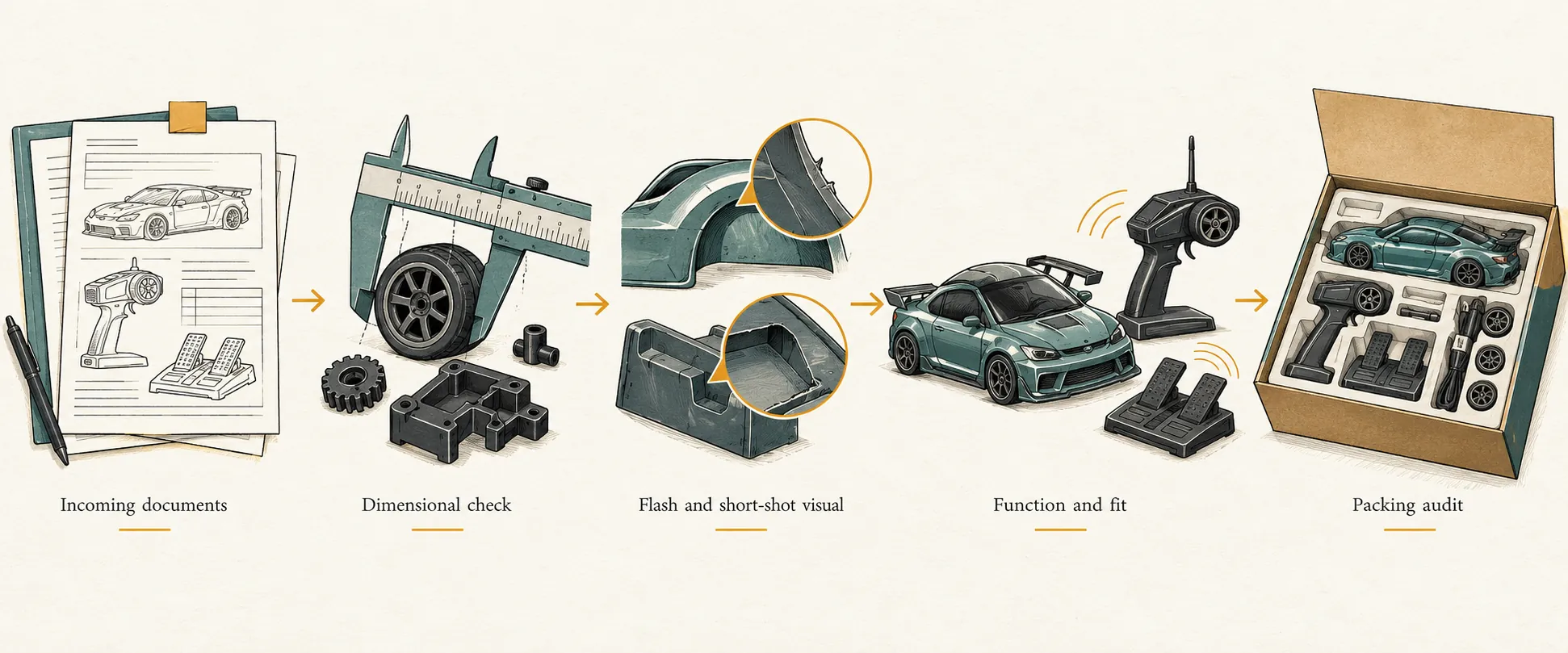
Approve a drift car’s pedal and remote-control description only when each published function matches evidence for the exact product variant and revision. For wholesale electric ride-on cars, check what the pedal does, what the remote controls, and which input takes priority when both are used. Record supplier wording separately from sample observations. Accept supported wording, hold unresolved claims, and reject wording that contradicts the matched evidence—without treating a description review as product safety approval.
Diagram: How to check a drift car pedal and remote-control descriptionWhich product and revision does the description cover?
Tie the description to the exact product, market variant, sample, and document revisions before judging its control claims.
Start a review record with the company SKU, supplier model reference, product family, intended market, and configuration. Add the sample identifier, remote identifier where available, quotation revision, manual revision, packaging artwork revision, and listing draft revision. Identify each photo or video by file reference; use timestamps for demonstrated actions.
Compare those identifiers across the quote, sample label, manual, carton markings, and proposed listing. A shared body shape or similar model name is not enough to transfer a control claim. If one identifier differs, establish whether the evidence still covers the target configuration before closing that claim.
Keep the approval scope explicit: quotation wording, sample description, carton copy, or listing copy. Approval of one version does not automatically approve later revisions.
What must the pedal and remote-control description explain?
| Pedal function | Specify what pressing and releasing the pedal does in the described operating mode. Distinguish a drive input from a separate brake pedal or another control; do not infer function from pedal shape. |
|---|---|
| Pedal technology, if claimed | Require matched technical documentation for wording such as Hall-sensor or proportional accelerator. A pedal photo or a clip showing movement does not establish the sensing technology. |
| Remote commands | List each claimed command separately, such as steering, forward/reverse, speed selection, or stop. Match the description to the supplied remote and demonstrate the claimed vehicle response; button labels alone are insufficient. |
| Remote supply and setup | State whether the remote is included or optional, and identify any pairing or mode-selection steps needed for the described functions. Check the agreed packing list and sample contents rather than relying on a promotional photo. |
| Pedal and remote interaction | Describe which commands remain active when remote control is selected and which input takes priority. If an override or stop function is claimed, request a demonstration of that exact interaction under the manufacturer’s operating instructions. |
| Drift-mode relationship | If drift operation is advertised, identify the control that selects it and whether pedal or remote functions change in that mode. Do not infer a drift function from the product name, voltage reference, or body styling. |
| Operating conditions and limits | Carry relevant setup conditions and mode restrictions into the final description. Do not turn a demonstrated stop command into an emergency-stop, fail-safe, or guaranteed stopping-performance claim. |
What evidence supports each control claim?
Evidence supports only the function, construction detail, or included item it actually establishes for the matched variant.
Keep three separate entries for every claim: the supplier’s exact statement, the observed or documentary evidence, and the buyer’s assessment. For example, a quotation stating “remote control” records a supplier claim. A matched photo can establish visible buttons. Neither establishes what the vehicle does when those buttons are pressed.
For functional wording, request a continuous demonstration that identifies the sample and remote, shows the selected mode, captures the control action, and shows the vehicle response. Have qualified staff conduct it in a controlled area under the manufacturer’s instructions. Log the conditions and timestamp rather than summarizing the clip as “all functions checked.”
Match the evidence method to the wording. Component documentation may support a pedal technology claim; an operating demonstration supports observed behavior; packing-list and sample-content checks support remote inclusion. These checks are complementary, not interchangeable.
Mark a claim verified only within the recorded scope. Use unverified when the evidence does not establish it, and conflicting when matched evidence contradicts it. An unverified claim does not prove the feature is absent or that the supplier cannot provide it.
Electric Off-Road SUV Ride-On: Description Review Example
| Product identity | Electric Off-Road SUV Ride-On; company SKU: ROT-353558; quoted product family: Kids SUV Ride-on. |
|---|---|
| Variant and configuration | Southeast Asia quote variant; supplier model reference: DLS-X16; system voltage reference: 24V; battery reference: 24V5AH × 1; motor reference: 555 × 2. |
| Quoted supplier statement | No additional feature input supplied for this variant. |
| Pedal description assessment | Completeness: not stated in the quotation. Evidence status for proposed pedal-function wording: unverified. Required follow-up: obtain the exact function description and check it against the identified sample and operating instructions. |
| Remote-control description assessment | Completeness: not stated in the quotation. Evidence status for proposed remote-function wording: unverified. Required follow-up: establish whether a remote is included, identify its commands, and verify any claimed interaction with the pedal. |
| Drift wording assessment | Evidence status: unverified. Retain the quoted SUV product family; do not relabel the product as a drift car based on its electrical configuration. |
| Recommended disposition | Hold approval of the control description. Continue identity and sample review without treating the hold as rejection of the product itself. |
| Closure condition | Attach the matched sample, media, manual, and packaging references; assess each proposed control claim; then obtain buyer sign-off on the corrected description revision. |
What should the reusable review worksheet record?
| Review identity | Record ID and worksheet revision; company SKU; product name; supplier model; market variant; configuration; sample identifier; remote identifier where available. |
|---|---|
| Versions reviewed | Quote, manual, packaging artwork, and listing revisions; media file references and relevant timestamps. Record the review’s scope. |
| Specified target | Exact proposed wording and intended behavior, including the operating mode and any stated conditions. |
| Supplier statement | Verbatim claim with its quotation or document reference. Keep it separate from the buyer’s observation. |
| Observation and evidence | What was actually seen or established; sample and document references; demonstration conditions; any difference from the specified target. |
| Claim assessment | Completeness: stated, not stated, or unclear. Evidence status: verified, unverified, or conflicting. Add a short reason tied to the evidence. |
| Decision and conditions | Accept, hold, or reject the wording; identify the approved replacement text or the precise condition preventing approval. |
| Responsibility and dates | Named reviewer and review date; responsible approver and decision date; follow-up owner and agreed due date. |
| Follow-up closure | Correction or evidence received; recheck result; final description revision; closure approver and closure date. |
When should the buyer accept, hold, or reject the wording?
Accept supported final wording, hold unresolved material claims, and reject wording that contradicts the matched evidence.
Acceptance can be narrow. If the evidence establishes one remote function, approve that function—not a broader phrase such as “full remote control.” Remove unsupported optional claims from the final copy rather than carrying them forward as assumed features.
Use a hold when the product identity, control interaction, or another claim needed for approval remains unresolved. Name the required correction or evidence and its owner. Reject the current wording when it misstates the observed function or describes a different variant; that decision need not reject the product.
Close the review only after the responsible approver signs and dates the final revision. Preserve earlier decisions and follow-up records for traceability. The record supports comparison and accountability; it does not by itself detect an undisclosed product change or replace safety testing.
Continue the buying conversation
Compare the ride-on range, packing references and product files before requesting a quotation.