 KIDS RIDE-ON TOYS WHOLESALE
review / BUYER DESK
Kids Electric Motorcycle Wholesale: Stabilizers vs Trikes
Compare two-wheel kids electric motorcycles with stabilizers against three-wheel trikes: geometry, controls, CPC retesting, battery documents and carton tracking.
Published 2026-11-28
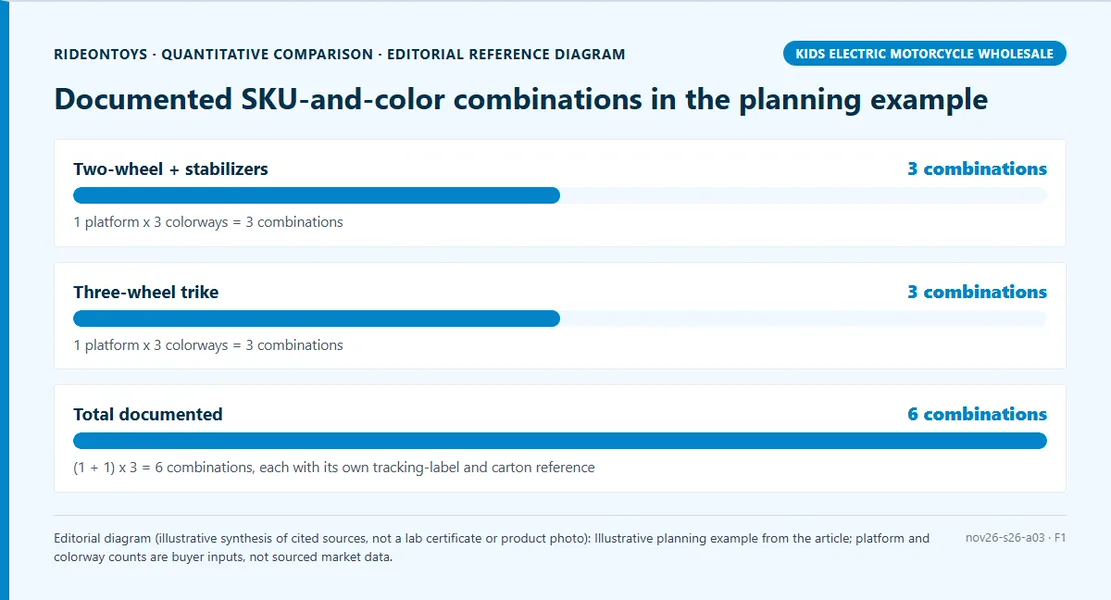
A retail buyer in Dallas is holding two quotes for the same spring program: a two-wheel kids electric motorcycle with bolt-on stabilizer wheels and a three-wheel trike with a molded rear axle. Both are quoted in 3 colorways. The buyer's real question is not which one looks steadier in a showroom photo, but which platform produces a clean, traceable file across 6 SKU-and-color combinations before the first carton ships.
That framing matters because the two platforms are not interchangeable under a single safety file. US consumer product safety authority defines a material change as a change to a product's design, manufacturing process or component source that could affect compliance, and requires retesting plus a new CPC after passing results. Moving from stabilizer geometry to a third wheel is a design change of exactly that kind, so the quotation has to say whether the trike is a new platform or a variant riding on the motorcycle's existing test file.
This review treats both options as procurement platforms inside the five RideOnToys groups: Electric Cars & SUVs; Electric Motorcycles & ATVs; Drift Cars & Go-Karts; Construction & Utility Rides; Theme & Specialty Rides. Speed, load, age grading, battery runtime, certification status and price stay quotation- or document-dependent at model level. What a buyer can lock down today is geometry, control layout, battery and charger references, CPC status and tracking-label fields.
Geometry fields that separate a stabilizer motorcycle from a three-wheel trike
Start with four measurable fields on the spec sheet: wheelbase, track width, stabilizer or third-wheel attachment method, and seat height relative to footrest. A two-wheel motorcycle with stabilizers carries a narrow rear track that widens only when the stabilizer arms are deployed, while a three-wheel trike carries a fixed rear track built into the frame or axle. Those are different load paths, different fastener counts and different failure points, so the quotation should list them as separate line items rather than one 'stable ride' sentence.
The attachment method deserves its own field. Bolt-on stabilizer arms that clamp to a rear axle tube can be removed or repositioned, which changes the effective track width and the rider's lean behavior. A molded trike rear axle is fixed at the factory. When the buyer writes 'stabilizer attachment: bolt-on, 2 arms, 4 fasteners per arm' into the request, the reply becomes comparable across suppliers instead of a photo caption.
Geometry changes also drive the compliance file. US consumer product safety authority's material change guidance covers design changes that could affect compliance, and a shift from two wheels plus stabilizers to three wheels changes the physical and mechanical profile of the product. The buyer's question in the quotation is direct: does the trike share the motorcycle's existing CPC and test report, or does it carry its own CPC with its own test dates and laboratory name? A 'yes, same file' answer without a document reference is not an answer.
A second geometry trap sits in the drivetrain. Teach Engineering's gear activities show that gears trade speed against torque, and that a smaller drive gear against a larger driven gear favors torque while the reverse favors speed. A trike with a heavier rear axle and wider track needs a different torque budget than a stabilizer motorcycle, so the quotation should name the motor-to-axle ratio or the drive configuration for each platform. That is an engineering comparison field, not a performance promise.
Illustrative planning example from the article; platform and colorway counts are buyer inputs, not sourced market data.Control layout: foot pedal, twist throttle and remote override as quotation fields
Control layout decides how a young rider learns the machine, and it belongs in the quotation next to the geometry. A foot-pedal motorcycle maps the go command to a floor pedal, which keeps the hands free for steering and mirrors the layout a child sees in a car. A twist-throttle motorcycle maps the go command to the right grip, which asks for a different hand and wrist motion. A three-wheel trike can use either layout, so the buyer should never assume the trike quote matches the motorcycle quote on controls.
Write three control fields into every request: throttle type (foot pedal or twist grip), remote override present or absent, and speed-mode count. The remote override field matters for retail programs that sell to families with mixed-age siblings, because a parent-held cutoff changes the store demo script. The speed-mode count matters for carton copy, because a 2-mode and a 3-mode version cannot share one retail description.
Keep every performance number out of the comparison sheet until the model-level document arrives. The quotation should state the control type and the mode count as configuration facts, and leave top speed, runtime and load to the model's own specification sheet. That split keeps the buyer's spreadsheet honest: configuration columns are filled from the quote, performance columns stay blank until the spec sheet and test report land.
For private-label programs, add a fourth field: which control parts carry the buyer's brand. A twist grip, a foot pedal and a remote fob are three separate components with three separate tracking-label implications, and the purchase order should say which of them are buyer-branded and which stay supplier-branded.
Battery, charger and toy-safety file: the documents behind the quote
An electric ride-on quote without battery and charger references is a shell. US consumer product safety authority lists voluntary battery standards including ANSI/CAN/UL 2272, UL 1642, UL 2054, UL 2595 and UL 4200A, and reports recalls involving battery-powered ride-on toys alongside hazards such as overheating, fire, electrical shock from chargers and thermal burns. US consumer product safety authority states that batteries must be properly tested with the product, in its intended use and with the charger as a system, and recommends a system approach covering thermal protection and charge and discharge protection.
That guidance turns into a document list. For each platform, the buyer records battery chemistry, pack configuration, charger model, and the standard reference the pack and charger are tested against. 'Safe battery' is not a field. 'Li-ion pack, charger model X, tested as a system with the product' is a field, and it can be checked against the test report.
Toy-safety classification is the next fork. US consumer product safety authority's toy definition excludes bicycles and tricycles, while ASTM F963 is mandatory for children's toys under 16 C.F.R. part 1250, and third-party testing plus CPC certification apply to products designed or intended primarily for children 12 years of age or younger. A tricycle-shaped ride-on therefore needs a classification decision recorded in the file: which rule set applies, which laboratory tested it, and which CPC cites it.
The CPC itself has hard requirements. It must be in English, be based on results from a third-party US consumer product safety authority-accepted laboratory, and contain 7 required elements including product identification and citation of each applicable children's product safety rule. Beginning July 8, 2026, importers of most regulated consumer products must electronically file certificates of compliance with U.S. Customs and Border Protection through a Partner Government Agency message set, so the certificate data has to be clean before the container leaves.
Tracking labels close the loop. US consumer product safety authority requires visible, legible, permanently affixed marks on the product and its packaging, to the extent practicable, showing manufacturer, importer or private-labeler name, location and date of production, batch or run information, and other source-identifying details. The tracking label is not a safety rule requiring certification under section 14(a)(1) of the Consumer Product Safety Act, and the CPC does not need to reference it, but the label still has to be on the goods.
The six-combination tracking math before you request a quote
Illustrative planning example, not a lab test or a price quote: a buyer compares one two-wheel motorcycle with stabilizers and one three-wheel trike, each offered in 3 colorways. Total documented combinations = (1 + 1) x 3 = 6 SKU-and-color combinations. Each of the 6 needs its own tracking-label reference and carton reference, because a shared carton code across colorways blurs which batch shipped.
The arithmetic also sets the retest question. If the trike is a new design rather than a variant, the 3 trike colorways sit on a separate CPC from the 3 motorcycle colorways, and the buyer is managing 2 test files, not 1. If the supplier changes the manufacturing facility, US consumer product safety authority states that the entire product requires retesting and recertification, which resets both files at once.
Volume planning runs on the same 6-combination base. At 24 units per combination, the program totals 6 x 24 = 144 units; packed at 2 units per carton, that is 144 / 2 = 72 cartons, or 12 cartons per combination. A 24-month program with a reorder every 6 months places 24 / 6 = 4 cycles and totals 4 x 72 = 288 cartons; a 3-year program at 2 cycles per 12 months places 3 x 2 = 6 cycles and totals 6 x 72 = 432 cartons.
Battery arithmetic for the quotation sheet: 12 V, 7 Ah and 84 Wh
Illustrative planning example, not a measured performance rating: a buyer receives a quote naming a 12 V, 7 Ah pack. Nominal energy is 12 V x 7 Ah = 84 Wh, and a two-pack configuration is 2 x 84 Wh = 168 Wh. Those two numbers belong in the buyer's spreadsheet because they make two quotes comparable on the same basis; they do not describe runtime, speed or load, which stay on the model's own specification sheet.
Charger arithmetic follows the same pattern. A 60-minute charge window at a 1.5 A charger output moves 1.5 A x 1 hour = 1.5 Ah into the pack, which is 1.5 / 7 = 21.4% of a 7 Ah pack. The buyer uses that percentage to sanity-check the charger model against the pack size in the quotation, and the test report remains the authority on whether the pack and charger were tested as a system.
Keep the units visible in every cell. A quote that says 'long runtime' cannot be compared to one that says '12 V, 7 Ah, 84 Wh, charger 1.5 A'. The first is marketing copy; the second is a configuration record that a laboratory report can confirm or contradict.
Editorial buyer decision sequence built from US consumer product safety authority tracking-label, material change and CPC guidance.Active-play context: what WHO and AAP guidance can and cannot prove
Public health guidance gives the buyer context, not a product claim. WHO reports that in children and adolescents physical activity promotes bone health, encourages healthy growth and development of muscle, and improves motor and cognitive development, and lists walking, cycling, wheeling, sports, active recreation and play as popular ways to be active. WHO also states that 86% of adolescents do not meet recommended physical activity levels, and that physical inactivity is projected to cost public health care systems nearly US$ 300 billion between 2020 and 2030, about US$ 27 billion every year.
That context supports a category story: wheeled play sits inside the 'wheeling' and 'active recreation' bucket that WHO names. It does not support a claim that a specific kids electric motorcycle improves a specific child's motor development. The buyer's catalog copy should say 'active wheeled play' and stop there, because no source in this file ties a model to a developmental outcome.
AAP's parent guidance adds a retail-checklist layer. It advises reading warning labels and age guidance, keeping toys and parts larger than the child's mouth, buying sturdy plastic toys, and checking that electric toys are UL approved. Those four items translate into four carton and listing checks: age band printed, small-parts statement present, shell thickness described in the spec sheet, and the electrical approval mark visible on the charger and the toy.
Two-wheel plus stabilizers vs three-wheel trike: buyer comparison fields
Every cell below is a field to fill from the model-level quotation and document set. A blank cell is a reason to hold the quote, not a reason to assume the answer.
| Field | Document to hold | Three-wheel trike | Two-wheel + stabilizers |
|---|---|---|---|
| Wheelbase and track width | Dimensional drawing per SKU | Fixed rear track built into frame or axle — quotation dependent | Narrow rear track; width set by bolt-on stabilizer arms — quotation dependent |
| Stabilizer or third-wheel attachment | Assembly bill of materials | Molded or bolted rear axle — quotation dependent | Bolt-on arms, 4 fasteners per arm — quotation dependent |
| Control type and remote override | Configuration sheet with mode count | Foot pedal or twist throttle; remote present or absent; 2-mode or 3-mode — quotation dependent | Foot pedal or twist throttle; remote present or absent; 2-mode or 3-mode — quotation dependent |
| Battery and charger documents | Battery and charger test report | 12 V, 7 Ah, 84 Wh pack; charger 1.5 A; standard reference — document dependent | 12 V, 7 Ah, 84 Wh pack; charger 1.5 A; standard reference — document dependent |
| CPC and tracking-label status | CPC in English plus label artwork | Separate CPC if a new design; separate label fields — document dependent | CPC citation list, lab name, test date; label fields on product and carton — document dependent |
| Carton reference | Carton marking file for all 6 combinations | 1 carton code per SKU-and-color; 12 cartons per combination at 24 units — quotation dependent | 1 carton code per SKU-and-color; 12 cartons per combination at 24 units — quotation dependent |
Buyer workflow: turning the comparison into a quotation request
The request starts with platform identity: two-wheel motorcycle with stabilizers or three-wheel trike, representative SKU, and colorway count. Then riding structure: wheelbase, track width, attachment method and seat height. Then verified configuration: throttle type, remote override, speed-mode count and motor-to-axle drive configuration. Then carton reference: one code per SKU-and-color, which for the 6-combination example means 6 codes. Then the next decision: does the trike carry its own CPC, or does it share the motorcycle's file?
Region changes the rule set, and the buyer should not blend them. The EU Toy Safety Directive 2009/48/EC sets essential safety requirements covering physical and mechanical, flammability, chemical, electrical, hygiene and radioactivity risks. Regulation (EU) 2025/2509 was adopted on 26 November 2025 and repeals Directive 2009/48/EC; it enters into force on 1 January 2026, applies after a 4.5-year transition on 1 August 2030, and requires a digital product passport for toys. A US CPC and an EU declaration are separate documents with separate deadlines, and a single quote sheet should carry a column for each market.
Date discipline matters as much as document discipline. The US consumer product safety authority eFiling requirement begins July 8, 2026, and the EU regulation applies from 1 August 2030. A program that ships in 2026 and a program that ships in 2031 sit under different filing and passport rules, so the purchase order should state the ship window and the market, not just the model name.
Finally, keep the catalog boundary visible in the buyer brief. RideOnToys does not claim a factory, product certification, fixed price, universal age suitability, maximum load, speed or battery performance without model-level evidence. The quote request is the mechanism that converts a catalog entry into a documented platform, and the buyer's job is to keep asking for the document behind each field.
Is a three-wheel trike automatically safer than a two-wheel motorcycle with stabilizers?
No. A three-wheel trike is not automatically safer; it is a different geometry with its own load path, fastener count and test file. The buyer's comparison has to run on wheelbase, track width, attachment method and CPC status, not on wheel count. A trike that carries its own CPC and a documented rear-axle assembly is a clean platform; a trike that borrows a motorcycle's CPC without a document reference is a hold.
Does changing from stabilizer wheels to a third wheel require new testing?
Yes, when the change meets US consumer product safety authority's material change definition, which covers design changes that could affect compliance. The supplier must retest the product or the changed component with a third-party US consumer product safety authority-accepted laboratory and issue a new CPC after passing results. A change of manufacturing facility goes further: US consumer product safety authority states the entire product requires retesting and recertification.
What should a wholesale buyer request before comparing kids electric motorcycle offers?
Request six items per platform: dimensional drawing with wheelbase and track width, attachment bill of materials, control configuration sheet with mode count, battery and charger test report naming the standard reference, CPC in English with lab name and test date, and carton marking file for every SKU-and-color. Add the tracking-label artwork for product and packaging, because US consumer product safety authority requires those marks on both. A quote missing any of the six is not comparable to one that has them.
Build the six-combination file before the first carton
Take the comparison table into the next quote cycle: two platforms, 3 colorways each, 6 documented combinations, and one document column per field. The RideOnToys catalog groups the range into Electric Cars & SUVs, Electric Motorcycles & ATVs, Drift Cars & Go-Karts, Construction & Utility Rides, and Theme & Specialty Rides, so the motorcycle and trike quotes can be pulled from the same sourcing desk and compared field by field.
Sources
www.US consumer product safety authority.gov — Batteries | US consumer product safety authority.gov
www.US consumer product safety authority.gov — Toy Safety Business Guidance | US consumer product safety authority.gov
www.US consumer product safety authority.gov — Children's Product Certificate | US consumer product safety authority.gov
www.US consumer product safety authority.gov — Tracking Label Business Guidance | US consumer product safety authority.gov
www.US consumer product safety authority.gov — Material Change Testing | US consumer product safety authority.gov
Continue the buying conversation
Compare the ride-on range, packing references and product files before requesting a quotation.