 KIDS RIDE-ON TOYS WHOLESALE
sourcing / BUYER DESK
Kids Electric SUV Wholesale: Carton Cube & Damage Control
Plan kids electric SUV wholesale orders with sample-measured carton CBM, knock-down container math, tracking-label fields and final-mile damage specs.
Published 2026-11-27
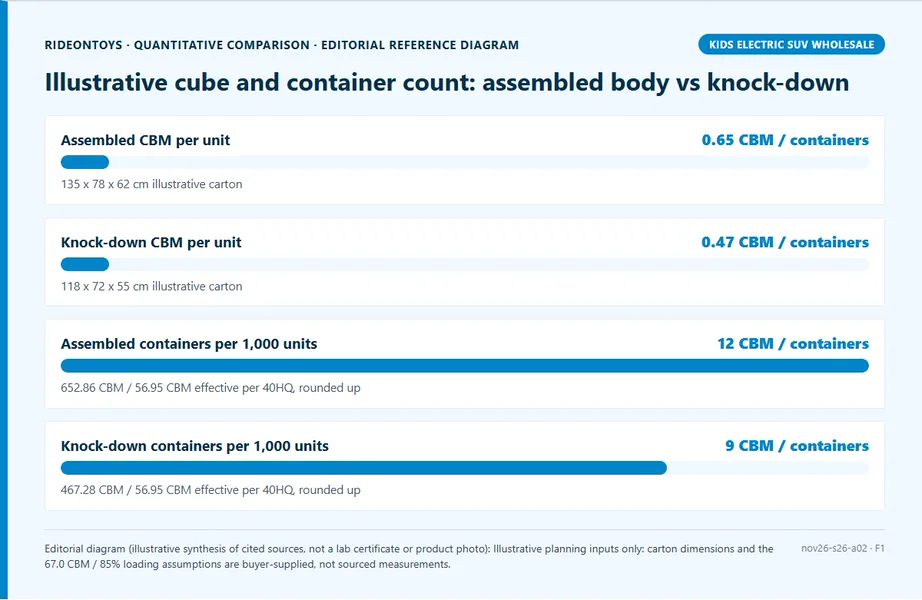
A two-seat kids electric SUV wholesale order of 1,000 units is a freight decision before it is a product decision. The body shell's largest face, not the 12 V battery or the remote control, sets the master-carton footprint, and that footprint sets your container count. On the illustrative inputs used throughout this article, an assembled-body carton of 135 cm x 78 cm x 62 cm yields 0.65286 CBM per unit and 652.86 CBM for 1,000 units; a knock-down carton of 118 cm x 72 cm x 55 cm yields 0.46728 CBM per unit and 467.28 CBM. That 185.58 CBM gap is the difference between 12 containers and 9 containers at an illustrative 56.95 CBM of effective loading volume per 40HQ.
RideOnToys organizes electric ride-on sourcing into five procurement groups — Electric Cars & SUVs, Electric Motorcycles & ATVs, Drift Cars & Go-Karts, Construction & Utility Rides, and Theme & Specialty Rides — and treats battery, motor, remote control, color and packaging as model-level attributes. Prices, MOQ, battery, speed, load, age, certification, licensing and delivery stay quotation- or document-dependent. What you can lock before a quote is the carton spec, the knock-down scope, the tracking-label data fields and the damage protocol.
Why the two-seat SUV shell, not the battery, sets your freight bill
A two-seat SUV body shell is a long, wide molding, and its longest face lands on the carton's longest face. CBM scales with length x width x height, so a longer shell at the same width and height adds cube in direct proportion: if only the length face grows 15% while width and height stay unchanged, per-carton cube grows 15%, from 0.65286 CBM to 0.750789 CBM. That is an illustrative arithmetic relationship on buyer-supplied dimensions, not a market observation about any specific model. The battery, by contrast, occupies a compartment of a few liters and does not move the carton's outer dimensions.
This is why a freight quote built from a supplier's one-line CBM figure fails at booking. The quote needs four measured numbers per master carton — length, width, height and gross weight — plus units per carton. Measure the sample carton yourself with a steel tape at the widest point of each face, including any bulged corner protectors, and weigh it on a calibrated floor scale. Accept the quote only when the measured length, width, height and gross weight match the spec sheet within 5 mm and 0.5 kg; a 2 cm discrepancy on the 135 cm face alone changes per-carton cube by 0.0097 CBM, which across 1,000 units equals 9.7 CBM.
The shell also drives the damage conversation. A two-seat body is a large, thin-wall ABS or HDPE molding; the corners and the battery-compartment face are the two zones that absorb impact in parcel and LTL handling. Carton spec, corner protection and battery-zone blocking belong in the same document as the CBM figure, because the packaging that protects the shell is the packaging that sets the cube.
Illustrative planning inputs only: carton dimensions and the 67.0 CBM / 85% loading assumptions are buyer-supplied, not sourced measurements.Reading a carton spec: the four numbers that must match the sample
A usable carton spec for a kids electric SUV carries at least six fields: master-carton length, width and height in centimeters; gross weight in kilograms; units per carton; and carton grade with edge-crush test value. Add the pallet pattern — units per layer, layers per pallet, pallet height — because pallet overhang and stacking limits consume the difference between theoretical and bookable cube. A 40HQ quoted at 67.0 CBM of usable internal volume does not load 67.0 CBM of cartons; at 85% loading efficiency after pallet and void allowance, the planning figure is 56.95 CBM.
Verify each field against the physical sample, not the spec sheet. Length, width and height: steel tape at the widest point, three measurements per dimension, record the maximum. Gross weight: calibrated scale, one carton, record to 0.1 kg. Units per carton: open one carton and count, because a mixed pack of body, wheels and charger can be listed as one unit while containing 14 pieces. Carton grade: read the box certificate stamp printed on the carton flap — it states the burst or edge-crush rating and the box maker's registration.
The compliance fields sit alongside the physical ones. For a U.S.-bound children's product, the tracking label must be visible and legible and permanently affixed to the product and its packaging to the extent practicable, showing manufacturer/importer or private-labeler name, location and date of production, batch or run number, and other source-identifying information. Those fields are printed, not stickered after the fact, so carton artwork approval is a pre-print gate tied to the production run, not a warehouse task.
Knock-down math: wheels, steering quick-pins and what actually shrinks the cube
Knock-down only pays when it reduces the carton's largest dimension. Removing four wheels and a steering wheel from a pre-assembled body lets the shell nest lower and narrower, which is how the illustrative carton drops from 135 x 78 x 62 cm to 118 x 72 x 55 cm — a 28.4% cube reduction per unit. Removing only the steering wheel while leaving the wheels mounted changes the height by a few centimeters and leaves the 135 cm length untouched, so the container count does not move.
The labor consequence is real and belongs in the landed-cost math. If wheel and steering quick-pin assembly moves to the importer's warehouse, an illustrative 12-18 minutes per unit becomes 200-300 labor hours across 1,000 units, plus receiving, small-parts control and a workstation. That labor is not free, and it is not the only cost: a change to the source of component parts that could affect compliance is a material change under US consumer product safety authority guidance, requiring samples tested at a third-party US consumer product safety authority-accepted laboratory and a new Children's Product Certificate. When the change touches only one component and does not affect other parts, a new CPC may combine earlier initial test results with the new component test; when the manufacturer itself changes, the entire product requires retesting and recertification.
The compliance trigger also depends on who the product is for. US consumer product safety authority testing and certification requirements apply to products designed or intended primarily for children 12 years of age or younger; a toy positioned for a 13+ audience may fall under ASTM F963 — mandatory for children's toys under 16 C.F.R. part 1250 — without third-party testing or a CPC. Age positioning is therefore a sourcing decision with document consequences, and a knock-down redesign that changes the marketed age band changes the certification file.
Assembled-body vs knock-down shipment: cube, containers, labor and compliance
Every numeric cell below is an illustrative planning input, not a sourced carton measurement or a supplier quote. Confirm dimensions on a physical sample carton before booking freight, and confirm the compliance column against the product's actual age positioning and component sourcing.
| Metric | Knock-down | Buyer check | Assembled body |
|---|---|---|---|
| Master-carton dimensions (illustrative) | 118 x 72 x 55 cm | Steel-tape the sample at the widest point of each face | 135 x 78 x 62 cm |
| CBM per unit (illustrative) | 0.46728 CBM | L x W x H / 1,000,000, recomputed from measured cm | 0.65286 CBM |
| Containers per 1,000 units (illustrative, 56.95 CBM effective per 40HQ) | 9 containers | Round up after applying pallet and void allowance | 12 containers |
| Assembly labor location | Importer warehouse, 12-18 min per unit illustrative | Cost the receiving bay hours before choosing knock-down | Factory |
| Small-parts control risk | Wheels, pins and hardware loose in carton | Count hardware bag contents against the parts list per carton | Contained at factory |
| Retest trigger under US consumer product safety authority material-change guidance | Component-source change may require retest and new CPC | Document which component changed and whether it affects other parts | No change from certified configuration |
From CBM to containers: a worked example with stated assumptions
Here is the arithmetic in full, framed as an illustrative planning example with buyer-supplied inputs. Assembled-body carton: 135 cm x 78 cm x 62 cm = 652,860 cm3 = 0.65286 CBM per carton; at 1,000 units, 652.86 CBM. Knock-down carton: 118 cm x 72 cm x 55 cm = 467,280 cm3 = 0.46728 CBM per carton; at 1,000 units, 467.28 CBM. Effective 40HQ volume: 67.0 CBM x 0.85 loading efficiency = 56.95 CBM. Assembled: 652.86 / 56.95 = 11.46, rounded up to 12 containers. Knock-down: 467.28 / 56.95 = 8.20, rounded up to 9 containers. The saving is 185.58 CBM, or 3.26 effective containers — 3 fewer containers on the order.
Two assumptions carry the result. The 67.0 CBM usable internal volume is a planning figure; actual 40HQ internal volume varies by container build and must be confirmed with the forwarder. The 85% loading efficiency is an allowance for pallet overhang, carton void and stack-height limits; a carton that stacks only four high because of gross weight can drop efficiency well below 85%, which pushes the container count back up. Recompute both numbers with the forwarder's actual container spec and your pallet pattern before you commit the order.
The 28.4% per-unit cube reduction is the number to negotiate against. If a supplier's knock-down carton measures 128 x 76 x 58 cm instead of the illustrative 118 x 72 x 55 cm, per-unit cube is 0.564224 CBM and 1,000 units need 564.224 CBM, or 10 containers at 56.95 CBM effective — one container more than the illustrative case. Carton dimensions, not the knock-down label, decide the container count.
Final-mile damage prevention: carton spec, battery zone and labeling
The battery compartment is a protected zone in the master carton, not an afterthought. US consumer product safety authority reports consumer complaints and manufacturer and retailer reports of battery and charger hazards including overheating, fire, electrical shock from chargers, thermal burns, electrolyte exposure and high-velocity ejected internal components, with incidents during use, storage and charging. US consumer product safety authority also notes recalls involving batteries in battery-powered ride-on toys and states that conventional lead-acid chemistries pose fire and explosion hazards. A carton that lets the shell flex into the battery compartment under a stacked load converts a cosmetic dent into a safety question.
Specify the protection in the carton drawing: minimum 20 mm EPS or molded pulp at all eight shell corners, a full-height corrugated liner on the battery-compartment face, and a battery box restrained so it cannot shift more than 5 mm in any direction when the closed carton is tilted 30 degrees. Write a drop protocol into the spec — an illustrative sequence of 10 drops at 76 cm on corners, edges and the battery-zone face, with a pass criterion of zero shell cracks and zero battery-compartment intrusion. Run the protocol on the actual sample carton before the production run, and photograph the result as the reference standard for the shipment.
Labeling is the other pre-print gate. The tracking label must be visible and legible and permanently affixed to the product and its packaging to the extent practicable, carrying manufacturer/importer or private-labeler name, location and date of production, batch or run number and other source-identifying information; the information may be in code form if consumers know whom to contact to interpret the code. The tracking-label requirement is not itself a safety rule requiring certification, and the CPC does not need to reference tracking labels — but a children's product still needs a CPC where other safety rules apply. Beginning July 8, 2026, importers of most regulated consumer products must electronically file certificates of compliance with U.S. Customs and Border Protection via a Partner Government Agency Message Set, so the certificate data must be final before the carton artwork is printed and the shipment is booked.
Market scope matters here. The US consumer product safety authority requirements above are U.S. federal rules. In the European Union, Regulation (EU) 2025/2509 was adopted on 26 November 2025, repeals Toy Safety Directive 2009/48/EC, enters into force on 1 January 2026 and starts applying on 1 August 2030 after a 4.5-year transition period. A carton printed for one market does not satisfy the other by default.
What the ride-on category tells you about the buyer behind the order
The end buyer of a two-seat SUV is a household buying movement, and the public-health data on movement is blunt. The WHO fact sheet reports that 31% of adults and 86% of adolescents do not meet recommended physical activity levels, and that physical inactivity is projected to cost public health care systems nearly US$300 billion between 2020 and 2030, about US$27 billion per year. Insufficiently active people carry a 20-30% increased risk of death compared with people who are sufficiently active. Those numbers do not sell a ride-on toy, but they explain why parents treat an outdoor ride-on as active play time rather than passive screen time, and why the product's outdoor durability — shell, wheels, battery enclosure — carries the value proposition.
The pediatric guidance adds a label check that belongs on the carton. The American Academy of Pediatrics parent guide advises that electric toys should be UL approved and that parents should check the label to confirm it. That makes the electrical-safety mark a visible carton field, not a hidden document: print it where a parent reads it at retail, and keep the supporting test report in the shipment file alongside the CPC. US consumer product safety authority recommends that batteries be properly tested with the product, in its intended use and with the charger as a system, which is the engineering reason the battery, charger and shell belong in one test plan rather than three separate ones.
The drivetrain inside that shell follows the same speed-versus-torque logic taught in engineering classrooms: describes gears as simple machines used to increase the speed or torque of a wheel, with a trade-off between the two when designing gear ratios, and frames gear ratios as the lever that adjusts a vehicle's power. For a two-seat SUV carrying two children on grass or gravel, the gear ratio is a torque decision, and it is a model-level configuration question rather than a carton-level one.
How much container space does a two-seater kids electric SUV take versus a single-seat model?
Container space is set by the measured master-carton dimensions, not the seat count: compute CBM per carton as length x width x height in centimeters divided by 1,000,000, multiply by units, then divide by effective container volume. On the illustrative inputs here, a two-seat assembled-body carton of 135 x 78 x 62 cm gives 0.65286 CBM per unit and 12 containers per 1,000 units at 56.95 CBM effective per 40HQ, while a knock-down carton of 118 x 72 x 55 cm gives 0.46728 CBM and 9 containers. Measure the sample carton before accepting any container count.
Does switching to a knock-down carton require new safety testing?
A knock-down carton does not automatically require new testing, but a change to product design, manufacturing process or the source of component parts that could affect compliance is a material change under US consumer product safety authority guidance and requires samples tested at a third-party US consumer product safety authority-accepted laboratory plus a new Children's Product Certificate. When the change affects only one component and does not affect other parts or the finished product's compliance, a new CPC may combine earlier initial test results with the new component test. A change of manufacturer requires retesting the entire product and recertification.
What must be printed on the carton for the U.S. market?
The carton and product must carry tracking-label information: manufacturer/importer or private-labeler name, location and date of production, batch or run number, and other source-identifying information, visible and legible and permanently affixed to the product and its packaging to the extent practicable. The information may be in code form if consumers know whom to contact to interpret the code, and the tracking label itself is not a safety rule requiring certification. Where other safety rules apply, the children's product still needs a CPC, and from July 8, 2026 importers of most regulated consumer products must eFile certificates of compliance with U.S. Customs and Border Protection.
Lock the carton spec before you lock the container
Send the model platform, representative SKU, target market and order quantity, and request the master-carton length, width, height, gross weight, units per carton and pallet pattern for the exact configuration you intend to buy. RideOnToys keeps prices, MOQ, battery, speed, load, age, certification, licensing and delivery quotation- or document-dependent, so the quote follows the carton reference, not the other way around. Start with the Electric Cars & SUVs group and compare model platforms against your measured sample before the freight booking.
Sources
www.US consumer product safety authority.gov — Batteries | US consumer product safety authority.gov
www.US consumer product safety authority.gov — Toy Safety Business Guidance | US consumer product safety authority.gov
www.US consumer product safety authority.gov — Children's Product Certificate | US consumer product safety authority.gov
www.US consumer product safety authority.gov — Tracking Label Business Guidance | US consumer product safety authority.gov
www.US consumer product safety authority.gov — Material Change Testing | US consumer product safety authority.gov
Continue the buying conversation
Compare the ride-on range, packing references and product files before requesting a quotation.